The Core Curriculum
Understanding and Working with AI
One curriculum. Multiple formats. Available through print, online, and classroom platforms — each designed to fit a different learning context.
The Program's Guiding Principles
Eight Habits of Mind for Working with AI
Each chapter of the program opens with one of these habits. Together they form a practical philosophy for anyone who works with AI.
1Seek the Opposing View click to read
AI is designed to agree with you. That's a problem. If you don't actively ask for the opposing view, you won't get it. AI defaults to reinforcing what you already believe. For anything with real stakes — a decision, a negotiation, an argument — it's your responsibility to ask for the downsides, the counterarguments, and the perspectives you'd rather not hear. Otherwise, you're sitting in an echo chamber with a very articulate mirror.
2Prompt with Purpose click to read
Prompting is a conversation with purpose. At first, working with AI feels technical — structures, strategies, careful wording. Over time you discover something simpler: it's a conversation where the subject never grows stale because you own it. The real skill is listening to what the AI gives you and knowing where to steer next. Each response is not an endpoint but a signal. You know fluency is developing when conversations become efficient and meaningful. That shift isn't a technique. It's a habit.
3You Are the Author click to read
You are the author. AI is the instrument. AI generates. You select, shape, and direct. The quality of any AI collaboration depends not on the tool but on the taste, vision, and judgment of the person using it. AI brings speed, variation, and tireless iteration. You bring lived experience, editorial instinct, and the ability to know when something rings true. Authorship isn't who types the words — it's who decides what stays.
4Iterate click to read
The best prompt is the second one. Your first prompt is a rough draft of your thinking. The real work begins when you see the output, diagnose what's missing, and refine. Each iteration teaches you something the previous prompt couldn't — because you hadn't yet seen what happened without it. Iteration isn't a workaround for imperfect AI. It's how the process is designed to work.
5Match the Tool to the Stakes click to read
AI is equally willing to help you name a pet or draft a legal contract. It brings the same cheerful confidence to both. But you shouldn't bring the same level of trust to both. What are the consequences if this output is wrong? The answer should determine how much verification, how many models, and how much of your own judgment you bring to the table.
6Know When to Stop click to read
Know when to stop asking AI. There's a point in any AI session where you've gotten what you need but you keep going — refining, asking for one more variation, tweaking something that was already good enough. The returns diminish fast, but the conversation is frictionless so you don't notice. This isn't about protecting your creativity. It's about respecting your time. Learn to recognize the moment when the next prompt is more a sign of addiction than a sign of improvement.
7Don't Outsource Your Discomfort click to read
Notice when you're outsourcing your discomfort. Some of the most important thinking is uncomfortable — sitting with ambiguity, making a decision without full information, facing a blank page. AI removes that discomfort instantly, and that feels like progress. But discomfort is often where judgment forms. If you find yourself reaching for AI every time something feels hard or uncertain, ask whether you're solving a problem or avoiding one.
8Protect Your Attention click to read
Your most original thinking rarely happens inside an AI session. It happens while walking, driving, cooking, staring out a window — when your mind is free to wander without a prompt and response cycle shaping its direction. Treat AI as a place you visit, not a place you live. The best collaborations with AI include time spent thinking without it. Take a break. Go outside.
Sample Lesson
Lesson 1.1 — Three Kinds of Intelligence
Every core lesson is accompanied by a video from the author. This is the opening lesson of the program, a great place to get a feel for the approach, the pacing, and the voice of the curriculum.
The curriculum spans eight chapters across two volumes, moving from the foundations of how AI works to its societal, ethical, and creative implications.
How It's Structured
Five Types of Lessons
This isn't a program you read and nod at. Every chapter is built around five lesson types that take you from concept to application to reflection.
📖 Core Lesson
The conceptual foundation of each topic. Clear, accessible writing paired with a video lesson from the author. This is where the big ideas land — what AI is, how it works, and what it means.
🔦 Spotlight
Essays and case studies that extend core ideas into the real world. AI in warfare, AI and Bitcoin, algorithmic justice, deepfakes. These are the lessons that make people stop and think.
🔬 Lab
Guided experiments with AI conducted in a methodical, scientific manner. It's one thing to be told how AI behaves. It's another to discover it yourself, including its biases, its limits, and its surprises.
✍️ Creative Project
A sustained creative writing project such as a novel, short story collection, poetry, memoir, or screenplay, developed in collaboration with AI. These lessons replace writer's block with writer's joy, guiding you toward what we call the immersive experience.
💭 Reflection
The joy of any journey is reflecting on where you're going and where you've been. Reflection lessons help you internalize what you've experienced, moving this beyond information and into genuine understanding. In the high school program, these become Discussion Days.
The Learning Philosophy

The Field Journal Approach
This program treats AI literacy as an expedition, not a lecture. As with any expedition, the most valuable asset becomes the notes you take along the journey.
Throughout the program, learners maintain a field journal where they record observations from labs, insights from spotlights, and reflections on their creative work. It's through this active engagement that the concepts stop being abstract and start to become real.
Access Options
The Same Curriculum, Multiple Formats
Whether you prefer print, a structured online program, or a full classroom platform, the core curriculum is the same. What differs is the delivery and the tools around it.
The Textbooks
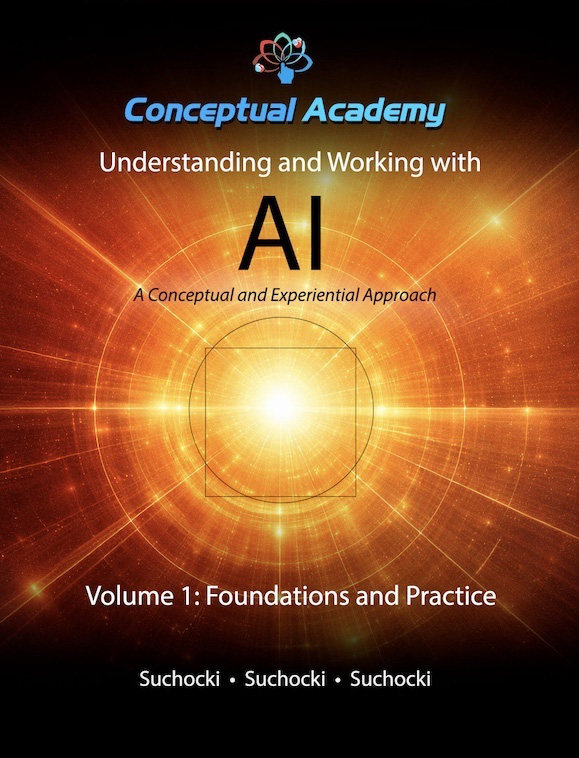
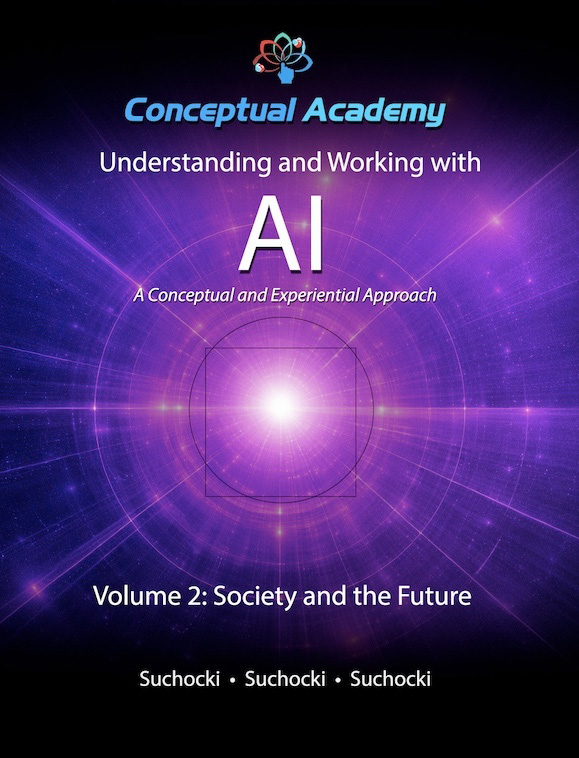
The most direct path. Order Volume 1 and Volume 2 as print-on-demand books, which are beautifully human designed and always up-to-date via IngramSpark, now in their second printing. QR codes throughout connect you to the video lessons, so your smartphone becomes part of the experience. Simple, affordable, and complete.
Conceptual Academy
The full online experience. The same curriculum pages are embedded directly into the platform, alongside embedded video lessons, interactive labs, AI experiments, chapter podcasts, and Alia — your personal AI learning assistant. Automated quizzes and progress tracking let you check your understanding as you go. Chapter 1 is free to try.
Enroll at Conceptual Academy →
PocketLab — K–12 Classroom
The complete high school classroom program, delivered through the PocketLab Notebook platform. Teachers get a full semester of structured lessons — Core, Spotlight, Lab, Project, and Discussion Days — with teacher guides, assessment tools, and AI experiments using Claude or the platform of your choice. The Conceptual Academy program is the ideal preparation for teachers who want to experience the curriculum themselves before bringing it to students on the PocketLab Notebook platform designed specifically for high schools.
Learn more about the PocketLab pathway →
Have Questions?
Ask Our Curriculum Assistant
Our AI assistant is trained specifically on this curriculum. Ask it anything about the program, the lesson types, the pathways, or what to expect.