For Public Libraries · A Case Study
Understanding AI, together.
A hypothetical story of how one assistant librarian used a shelf of books to help his town make sense of AI — and found that the very technology people feared would isolate them could bring them together instead.
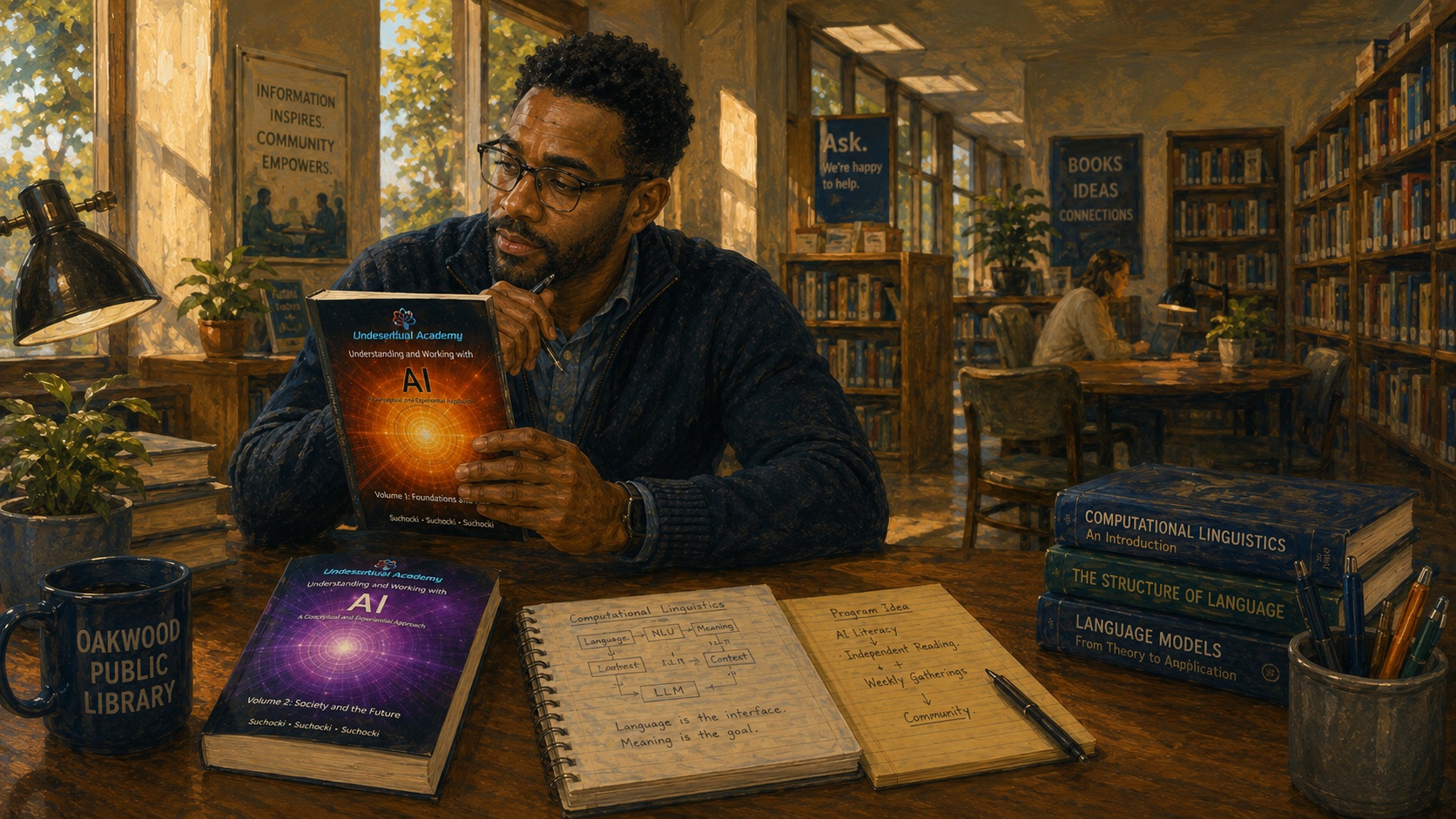
Rich Richards is an assistant librarian at the Oakwood Public Library, a position he took after finishing a bachelor's degree in English. He's making slow but steady progress toward his MLIS, one graduate course at a time — and the course he's in now, computational linguistics, is what introduced him to a book. It was called Understanding and Working with AI, and what struck Rich was how far it went: not a manual for using a chatbot, but a real education in what AI is and isn't — what sits under the hood, why language models behave as they do, where they fail, and how a person keeps their own judgment in charge while working with them. The books also spent real time on best practices: verification, iteration, authorship, and how to use AI in writing without letting the machine flatten your voice.
Rich brought the books to the head librarian. She immediately thought of the library's Thursday writers' cafe. “They might love this,” she said. Rich agreed — up to a point. Writers had particular reasons to be both interested and angry at the very idea of AI. Though some were already experimenting with AI, wondering what was actually happening under the hood, and asking how to use it without surrendering the craft that made their work theirs. The cafe might even decide to explore the books together in whatever way suited them. But Rich had something broader in mind. “I'm thinking about everyone else, too,” he said. “The people who keep hearing about AI at work, in school, in the news — and have never had a place to sit down and really understand it.”
A recurring class series was not the library's usual programming model. A one-night presentation was. So that was where Rich started. The library scheduled an evening talk: Understanding AI — What's Under the Hood, Why It Matters, and How to Work with It Well. He expected a respectable crowd. Instead, the room filled. People came with questions about jobs, school, misinformation, creativity, privacy, and what these systems were actually doing when they seemed to think. Along with his graduate-level training, Rich used the books as his framework. He showcased an interesting AI experiment: he told the machine to forget their discussion until he used the word “pickle” — and then tried, question after question, to get it to remember early. Without revealing the results, he told the crowd that it told him more than he expected. He was also sure to leave plenty of time at the end for questions.
Near the end, a woman in the audience raised her hand. “Could we do something like a book club?” she asked. “Not another lecture — a group that actually works through these books and meets to talk about them?” Rich had not planned for that question. He looked toward the head librarian, who gave him the smallest of shrugs. “Maybe,” he said. “If you'd seriously be interested, write down your name and contact information before you leave. Let me see what I can put together.”
After the room emptied, Rich counted eight names. That was enough to try. The library ordered a lending set of Understanding and Working with AI, and Rich reserved one of the conference rooms for Tuesday evenings, which was a time that worked for him personally. In his message to the eight participants, he explained that library copies would be available to borrow and included a link for anyone who preferred to purchase a copy of their own. Eight chapters suggested eight weeks of reading, with a first meeting to get oriented and a final evening to share what people had learned and made. What had begun as a one-night library presentation was turning, at the audience's request, into something closer to a book club for understanding AI.
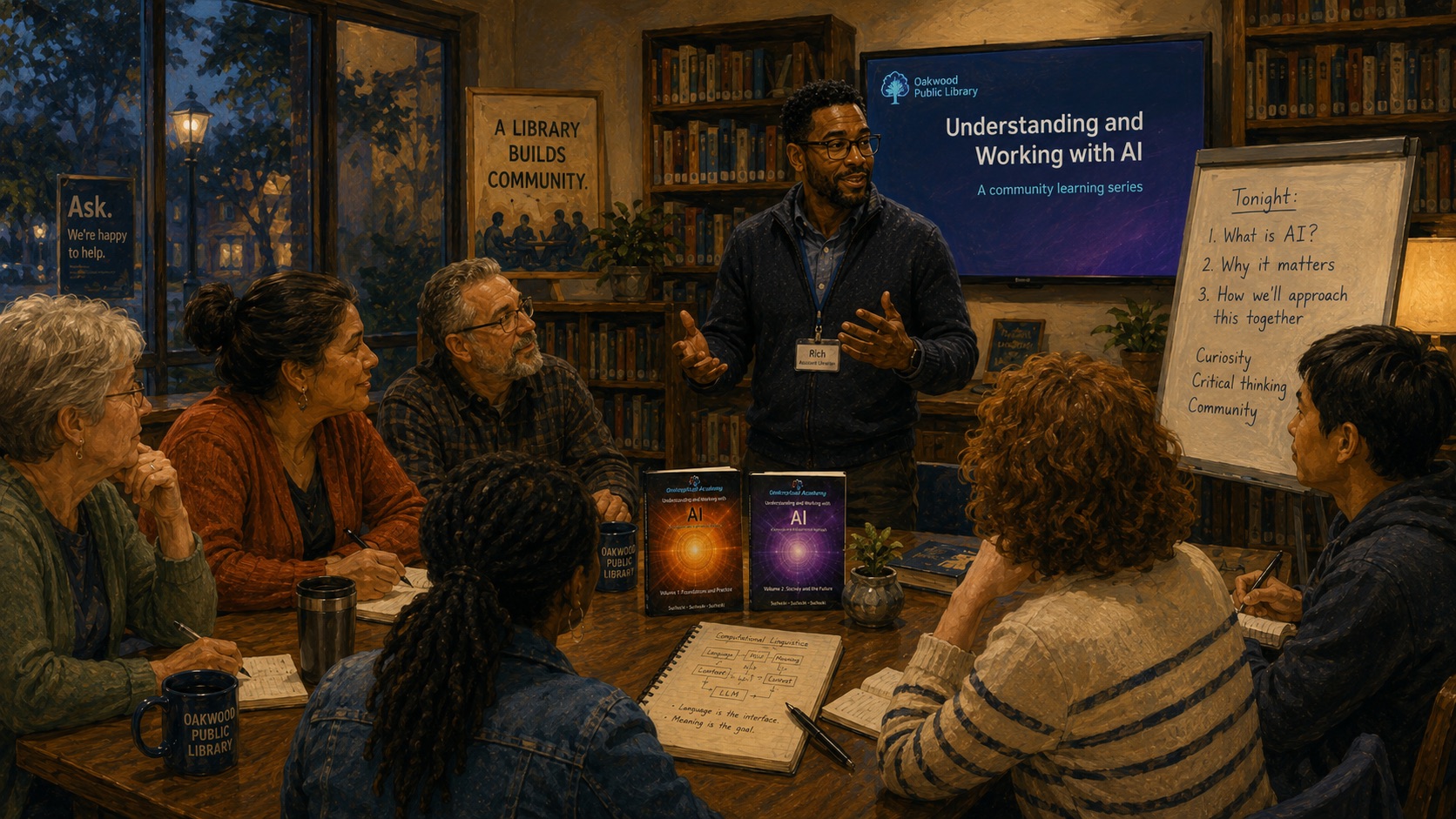
The eight were a cross-section of the town. A retired accountant who kept reading about AI in the news and felt he was falling behind. A high-school teacher unsure what to tell her students. A nurse. A small-business owner. A few members of the Thursday writers' cafe, curious both about how the technology actually worked and about better ways to use it in their writing. They had different reasons for coming, which turned out to be exactly what made the conversation useful. This was not the writers' group with a new topic pasted on. It was a general-public learning group in which writers happened to be members of the general public, too.
Rich explained the format that first Tuesday. One chapter a week, read mostly on your own. Each chapter came with AI labs — structured experiments run on a real chatbot to see where the technology was brilliant and where it quietly fell apart — a field journal to record what you found, and a creative project that let you put the ideas into practice. The writers could naturally push deeper into authorship and craft; others might write memoir, explore a professional question, or create something they had never tried before. No one had to use the program in exactly the same way. The shared chapters simply gave them enough common ground to meet every Tuesday and have a real conversation.
“And one request,” Rich added. “Some of you will move faster than others. If you finish a chapter early, resist the urge to race ahead. Explore one of the labs more deeply, work on your project, or bring a question back for the group. That way we stay close enough together to actually talk when we meet.”
The talking was the point, and it surprised him how much of it there was. They compared what their chatbots had told them — the confident answers that turned out to be wrong, the flattery, the moments the machine handed their own assumptions back to them as fact. The writers were especially interested in the science of why the model produced the language it did, and in the huge difference between using AI as a subordinate collaborator and letting it become the author. Others brought questions from medicine, teaching, business, and everyday life. Rich broke the group into smaller teams so the conversation stayed intimate, and reshuffled the teams every week, so that by the end everyone had worked with everyone. The book's reflection questions were the icebreaker; the teams talked, then the whole room talked.
After every two chapters there was an informal unit exam that came with the program. The week before, he'd hand it out to take home — on your own, and please, no AI on this one. Then the session would open with each team taking that same exam together, followed by discussion. The solo attempt showed them what they knew; the team attempt gave them a reason to talk through what they didn't.
Most of them had computers at home; a few didn't, and came in to use the library's. Rich would spot them during the day, utterly absorbed, hours vanishing — running one more lab, reading ahead, or deep in the literary project the books had led them to. It made him smile at the quiet inversion of it: people once came to the library to borrow a story. These folks came to make sense of the strangest new thing in their lives — and some stayed to write a story of their own.
They came to understand AI. They stayed because of one another.
By the fourth or fifth week, Rich noticed something else. They came because Tuesday night had become something they looked forward to. They wanted to hear how others were making sense of it all, and to be heard in return. Learning together was proving more engaging — and more honest — than puzzling it out alone. They had started to become a group.
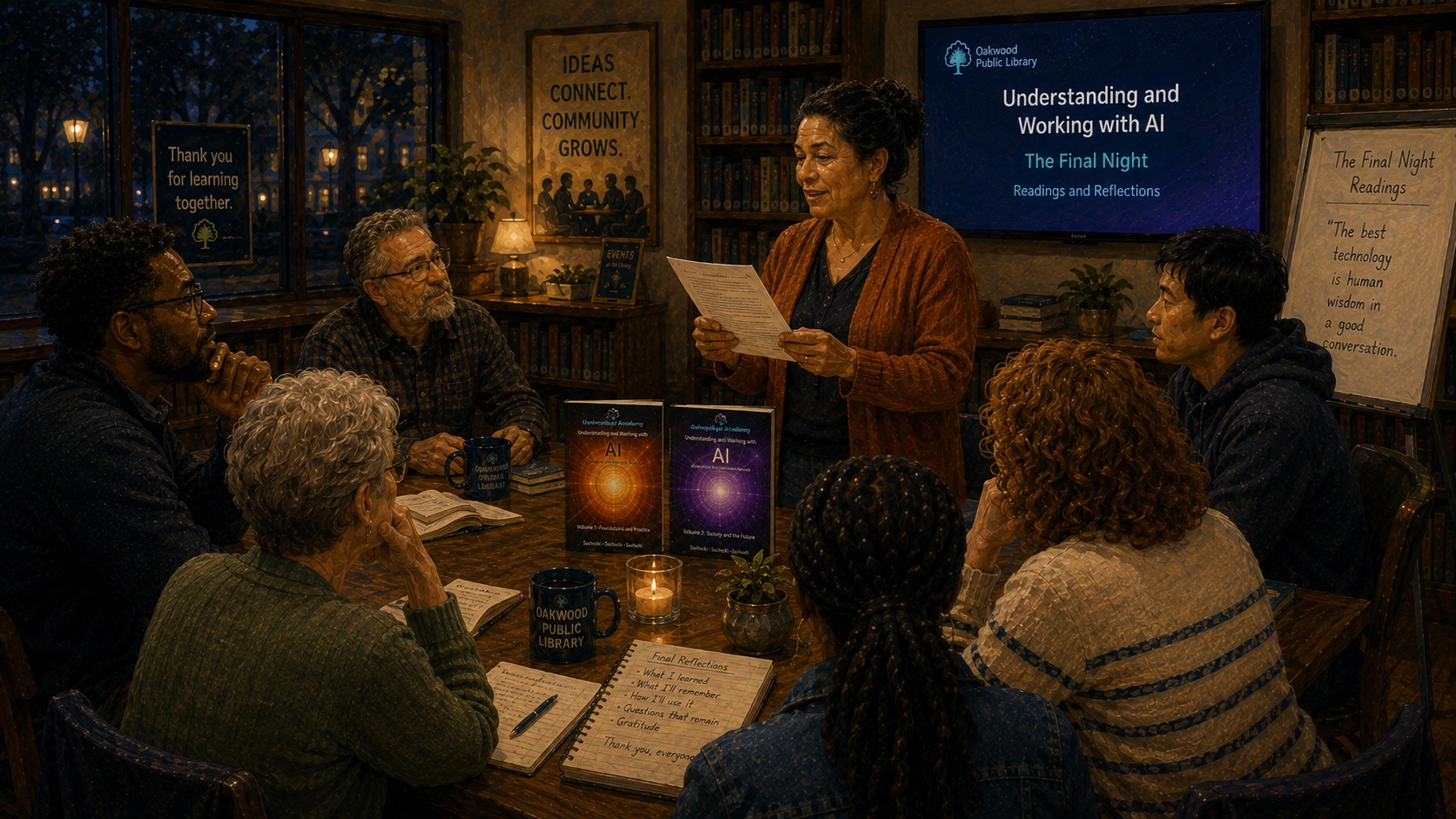
On the last night, the teams reviewed their final exam and then, almost impatiently, turned to the sharing. One by one, people described what they'd made and read a passage aloud — each passage now free of any telltale AI idioms, rich with the author's own voice and vision. Some had written short fiction, some memoir, one a set of poems, one a screenplay scene, and one an essay on what AI might mean for her own profession. The room leaned in. The applause after each was sincere, heartfelt, and earned. Seven of the eight had made it all the way through, and on most Tuesdays six or so had filled the room — one or two always away for the evening. Ninety minutes disappeared faster than Rich expected; they ran late into the evening, and few minded.
Six to eight, Rich decided, had felt about right — small enough for everyone to be heard, varied enough to keep the conversation alive. What he kept turning over instead was the day and the hour. A Tuesday evening had worked for these eight, but he thought of the people the slot must have quietly turned away: the parent who couldn't do weeknights, the shift worker, the retiree who'd rather come at ten in the morning. Maybe a weekend group next time. Maybe a daytime one. Questions for the next round.
What everyone understood by then was that they didn't have finished works. They had beginnings — first drafts that still needed to cure, still needed human judgment. That was the lesson in miniature: AI could open roads they couldn't have traveled alone, but it couldn't walk them for them; the tool could lift what they made, but only they could make it theirs. A few had become genuine friends and decided to keep meeting on their own. Rich pointed the rest toward the library's own writing circle as well as FluentVoices.org, where people form online circles to keep learning and creating together — the community continuing well past the last session.
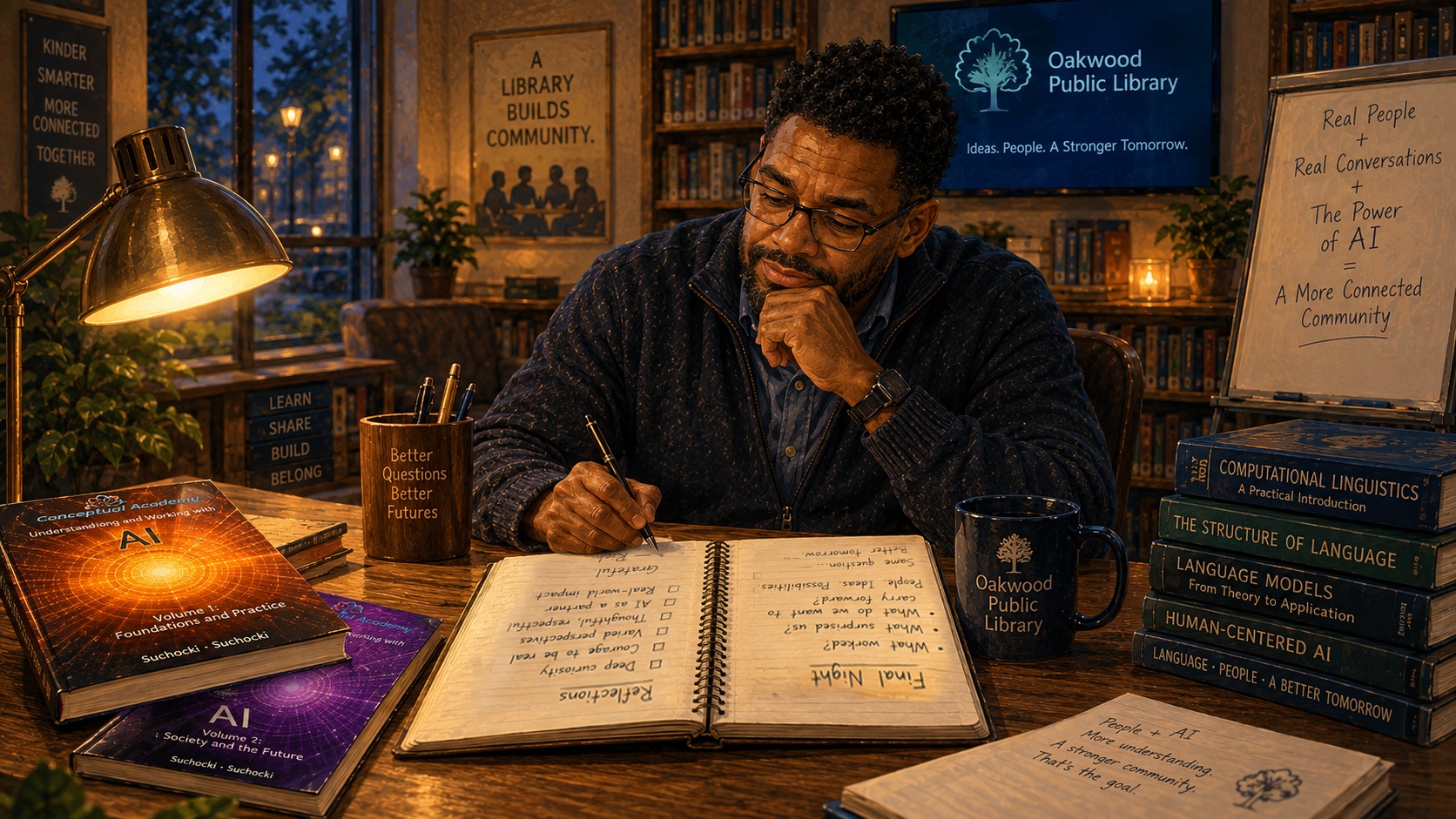
After they'd gone, Rich sat alone in the library's classroom with his own field journal — the same kind he'd asked all of them to keep — and tried to name what had happened. So much of our technology, he wrote, seems to isolate us even as it promises to connect us. And here was AI — the very thing many feared would deepen that isolation — doing something like the opposite: not only sharpening what these people understood and lifting what they could make, but drawing them together to do it. With the library as the third place and the wish to understand as the reason to come, they'd built a small community out of the very technology that was supposed to pull them apart.
This is not what I expected, he wrote.
Then he added one more thought. None of it had happened automatically. The books had provided the pathway. AI had provided the occasion. But someone still had to give the first talk, listen when an audience member asked for more, open the room on Tuesday nights, welcome the strangers, and help them become a group. That had been his part. And the library had done what libraries do at their best: given people a place to learn, to create, and to belong.
Someone still had to answer the call, open the room, welcome the strangers, and help them become a group.
A word from the author
Could this happen at your library?
“Don't use AI to avoid the road that builds you. Use it to reach roads you couldn't travel before.”
The idea at the heart of the program — and of the reflection students read before they begin.
Read “Why Write With AI” →We're looking for people to explore this with us.
The story you just read is hypothetical — our best guess at how this might work. How it actually works is what we hope to find out, alongside public librarians and community educators willing to try it.
Get in Touch →Getting the books
For a library
Order a lending set through Ingram Library Services (ipage) — the channel you already use — by ISBN:
Vol. 1 — 979-8-9998297-6-4
Vol. 2 — 979-8-9998297-7-1
For your own copy
Prefer a copy of your own? Order either volume directly:
This story is set in a public library — but much of it applies to school libraries too. See the school library page →